Friday, 24 July 2015

Possum Shaving

Using the possum that I had from the first week I wanted to apply some physical techniques that would change it into more of a leather product.

I used a variation of tools to shave the possum, my hunting knife proved the most efficient.
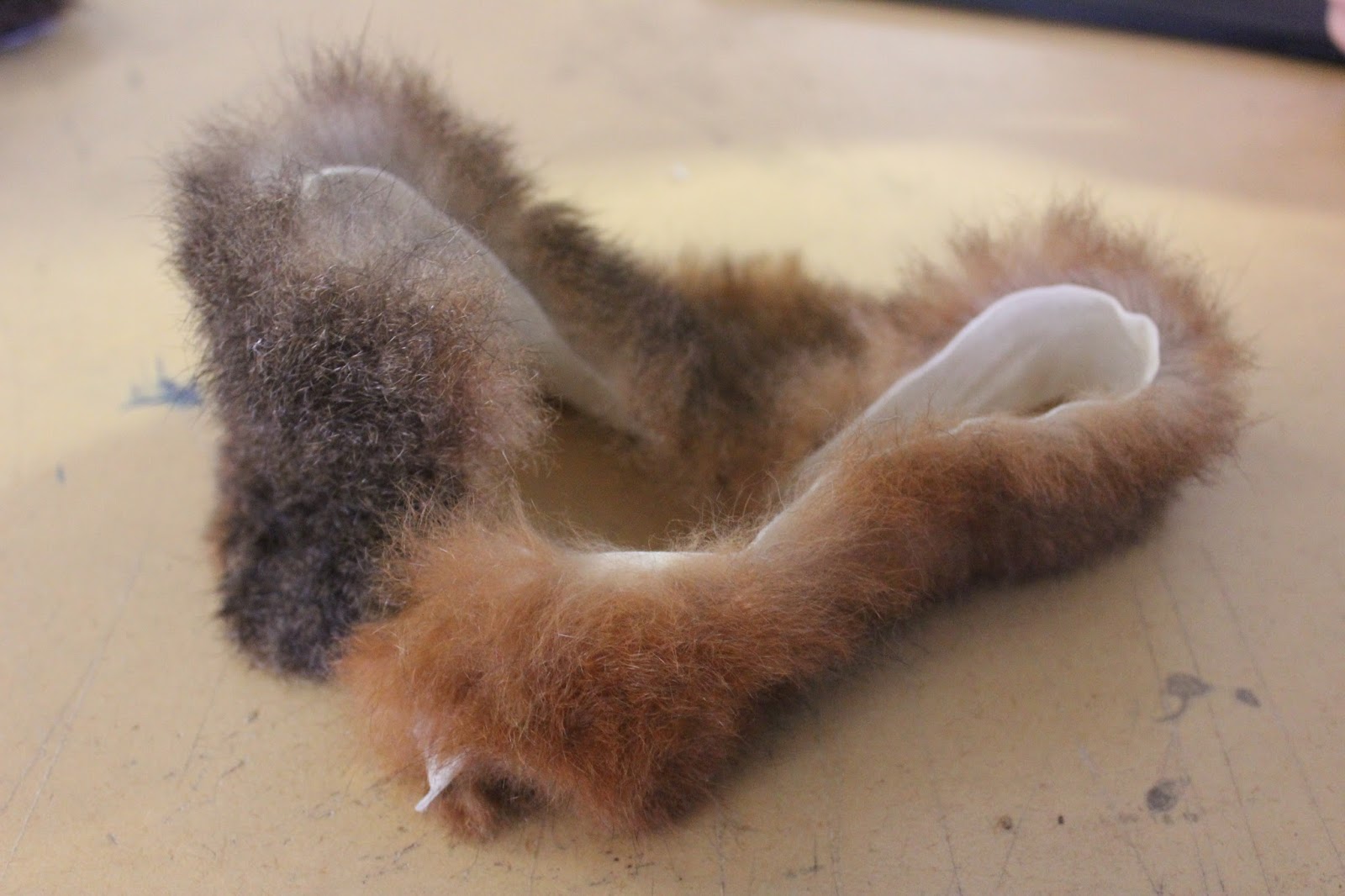
Long piece of possum

Possum fur, It needs to be cut out of the way

Cut possum Fur.

Short fur.

After a possum haircut.

Shaved with an array of tools

Contrary to belief, a disposable shaver isn't the best tool for the job.

My array of possum shaving tools

The possum skin is somewhat like leather, but thinner, almost a parchment.

Very thin/

It is very maleable, and has frayed edges.

Even with the knife I didn't get all of the fur off. I wasn't concerened with being too precise.

The long bald possum piece.

A contrast between fur and shaved sections.

Thursday, 23 July 2015

Heat + Smash

Heat.

We can experiment on heat with materials such as wood and paper.
I brought in an old piece of treated and painted timber, and some toilet paper.

Wood, before heat.
Post heat gun.
The heat gun was quite effective on wood, cracking it, scalding it, and charring the paint.
The large crack was a result of the concentrated heat, as was the blackening.
The heat gun melted and burnt the paint.
Marks made by a soldering iron.
The effects of the soldering iron were underwhelming and slow.
You needed to melt through the two layers of paint very slowly in order to have an effect on the timber.

No, thats not a dirty piece of loo paper, it is a scorch mark. I thought the soldering iron would heat the paper up enough to burn it and ignite a flame, but no, in fact the TP was rather unreactive.

I could hold the paper tight around the soldering iron and this is the best scorch I got.
I decided to try boiling the wood to see what would happen, it softened the wood a lot, softening the glues, and refreshing the smell of pine it once had.


After boiling the wood for a few minutes I smashed it a bit with a hammer. This split both the paint and the timber itself.


Splitting of paint as a result of heat.


It was revealed that teh timber was a lot softer after being boiled and soaked in water. This made it more maleable, the hammer not only split the wood but also squashed it in places.

When the wood had time to cool it hardened as before, yet also retained its squashed, smashed, and split state.

Wednesday, 22 July 2015

Leather Pyramid

Leather has interested me throughout this course. Last night whilst waiting for my plastics to bubble down I sat near the fire sewing up the six edges of this leather pyramid shape. made from 100% the triangles were first cut out, then holes were made using a hammer and nails, and then leather strips were used as a cord to sew it all together.
All sewn up.
 Next I dropped the leather pyramid into a pot of boiling water, the effects of this surprised me, I knew that leather was supposed to harden in boiling water.
Boiled pyramid, 'tough as old boots.'
 In the process of hardening the whole pyramid shrunk, I assume that in the shrinking the leather compacted into a harder form.
All of the sewn sides tightened when boiled.
 The final result was a very strong shape.
Some warping around the sewn sides.

Saturday, 18 July 2015

Bang Smash Crash

During Friday's lecture we went into the workshop and discussed a few ways of interacting with our materials that might bring about an interesting result. Some of these were hitting, pulling, squashing, scraping, poking, and an array of other methods.
This sping was squashed by repetitive impact with a hammer, it took a while but gradually I was able to change its form.
Another image of the bent spring.
By bashing the leather with a hammer it took on any imprint of any imperfections in the surface it was resting on.
Bashing the leather split it in places.
I used a vice to squeeze leather pieces together.
Here you can see that the bottom of the leather is starting to squeeze together.
And the top of the leather is pushed away from itself.
When removed from the vice the Leather bits stayed attached to each other, stuck by the pressure if the vice.
I smashed the hook and misshaped it.
I was able to bend one of the ends up, although strong steel, it became malleable with enough pressure.
In the process of bending it I scratched and damaged the steel.
I also smashed the large piece of steel, scratching it and squashing it.
I was able to squash it flat whilst hitting against a small anvil, whilst holding it, I didn't realize that the metal was see-sawing into my hand, creating a blood blister.
All in all, the results above were fairly predictable, even me damaging myself in a minor way. It was however, a good outlet for anger and frustration. With further experiments to some of the materials I'm sure I can expose some interesting features, and create something I have not seen before.

Thursday, 16 July 2015

Fresh Materials.

After our first lecture and tutorial we were told to bring with along some different samples of materials ranging from woods, metals, and plastics, to leathers, and paper.

Initially my interest lay with food; being able to manipulate food as a material in a respectful way that did not upset the cultures of New Zealand. however, as food isn't on the list of materials I have changed my angle. 

I am still very interested in natural materials, taking from nature, using something, and then when its use is over, giving it back to nature to decompose and turn into something new.
Scrap of Possum
Wednesday after the tutorial I went to two shops that I love, The first was the sheep factory that used to be located on the on the eastern side of Mt Victoria, it has now moved to Lyall Bay. Here I was able to find some cheap possum scraps and some small sheepskin patches.
Rolling the possum scrap up changes its form completely.

The skin of the possum, which has been cleaned and treated. Underneath all of the fur it is very thin.
Two different coloured sheep patches, they feel quite processed and artificial.
The underside of the sheep patches doesn't feel like natural skin, but a heavily treated material.
the second is 'Made on Marion' which used to be known as Goldings, it is a little craft store on Marion street that has all sorts of materials and implements for craft work, my favourite section here is the leather bins. I was able to find some affordable, yet surprisingly large leather scraps, as well as a not so cheap, yet completely gorgeous goat hide. I am saving the goat hide for another project, it is too beautiful to experiment on.
It just so happened that the weekend prior to this course starting I was deconstructing an old lazy-boy couch, the couch had an interesting mechanism with all sorts of bits and bobs made from steel. Here are some interesting pieces.
I can only imagine that this is useful for inclining the chair.
Springs tightly coiled.
This piece of wood was one of the feet, I couldn't throw it out as it had some interesting marks from wearing over time.
This hook was connected to a spring.
This solid hunk of steel was on either side of the chair and helped to put the foot rest mechanism out.

I have an array of interesting bits and pieces of different shapes and materiality, now I will interact with them and explore their physical properties.