Showing posts with label Holga. Show all posts

Thursday, 18 September 2014

Process

Using my new birthday present Go Pro I documented the physical process of projection of my photos, destruction of the bonnet/screen/canvas and rephotographing the photos.
I arranged this into a simple video shown below.


In my final presentation I will use the video below. It is the process as documented by the GoPro camera with my final selection of images interspersed throughout, at the times when I photographed them.


In this project the process I followed was equally if not more important than the final images. It required many iterations and processes, layering of images, trial and error, and most of all the help of others. I relied heavily on my family for this project. 

My girlfriend helped me throughout the analogue photography process. Together we discovered interesting subjects including a picnic beach scene with the dog Ken.
My dad helped me at pick-a-part to dismantle the bonnet of a car and bring it back to his house, providing me with a place where I could destroy it.
My niece and nephew ate lunch with me before I began photographing and destroying the bonnet. The setup doubled as a makeshift movie theater. Where we watched a film.


Then as you will see in the videos above they helped in certain parts of the destruction of the bonnet. One layer of destruction included running over the bonnet and leaving wheel marks over it. To do  this my nephew and I painted the wheel of an old wheelbarrow and rolled the painted barrow over the bonnet.

This project was definitely a team effort. It was a memorable process for me and no doubt a memorable process for the others who helped out.

Tuesday, 16 September 2014

Car Graveyard

Saturday my dad and I went up the hill in Wingate to Pick-a-part. This place is a massive car graveyard where tinkerers and scavengers from all walks of life come to salvage useful car bits and bobs.
I wanted either a car door or bonnet that was white so I could project images of my photographs onto it. I discovered a suburu bonnet in good condition that had a  scoop in it. To buy it the asking price was $70, I thought this was a bit expensive for something I would soon be destroying. still, I bought it, I guess that is what they mean by suffering for ones art. 


Images from: http://ferguscunningham.com/2012/08/25/pickapart/

Tuesday, 2 September 2014

Run it over


Today I ran over my photos.

I taped a negative print of three images, and one devoloped image to one of the rear tyres of my car. I reversed a few metres and then drove forward to my original position.

This is what happened.

 When the car drove over the negative print it was torn into three pieces. It is not very strong or maleable. Here we can see marks of dust where the car was pushing the negative into the dirt. The lines are caused by lines of space in the tyre.

 
You can see more of the cracking and scrathing of the negative on this side and less of the dust print.


I am unsure of what happened in the two above images when scanning them. On the left is the back side of the printed image, on the right is the printed image s front side.


Next I taped a negative to the wheel of a bike and the developed image on the other wheel

This is what happened.

Here we see the negative and some of the texture that the bike gave it.
Here we can see the otherside of the film where there is dust marks where the bike tyres have been put under weight in this point.


Again I am unsure as to what happened on the developed photos on scanning, however in the second image you can clearly see a tyre mark.

Monday, 1 September 2014

The hangover.

I had an idea and it sparked many more ideas.
I will have a couple of mates over and we will watch the hangover trilogy whilst enjoying a few (or more) beers. Using the Holga I will document the night and the aftermath in the morning. 

Once developed I will put the images in a shallow tray and pour beer over them. I will photograph the images through the beer using my cannon DSLR.

An interesting idea that may have more interesting results.

Drunk Driving

To bridge the gap between my first idea of transport and second idea of a hangover, I have thought it may be interesting to approach the subject of drunk driving. The way I am envisioning this is a series of images that have been altered in several ways.

Firstly using the Holga I will take a series of images that construct a narrative around a night of drinking and partying and then later driving and ultimately a crash.

Next I will apply different textures to these images for example The photograph will be scratched as if by glass in the image of the broken beer bottle. There will be mud and grass smeared on the photographs of the car as it drives off of the road. There will be visible tears in the photograph and blood smears on it in the image of the after crash.

Next these textured images will be projected digitally onto a white car bonnet. Throughout the series the car bonnet will gradually become destroyed. I will physically destroy the bonnet before taking the next photograph.

This will produce the final digital images. I am yet to decide upon a finla output for these digital images.

Tuesday, 26 August 2014

More experiments with the film

My enthusiastic use of the Holga camera has led me to my first disappointment.

I approached the camera with some old black and white film I had found and bought off of trade me. and then went about taking images where and when I thought fit to do so. Without much consideration  I took these images, eager to make comparisons between not only the colour film and the black and white film, but also between the square aspect ratio and the rectangular aspect ratio.

I shopped around at places to develop the film. I had previously used image lab who were reasonably priced and I had inquired in the photo warehouse who were ridiculously expensive. Wellington Photographic's offered me the best price yet; and the quickest service.

Upon picking the images up today I was shocked and disappointed that only only one of the images had exposed the way I had anticipated. A couple of the others had exposed just enough to identify what they are, but the majority of the images were not exposed sufficiently.

A lot of the images have strange white or grey sections on them and all of the images, although it is most noticeable in the darker images, have white specs all over them that sometimes appear to look like the sky on a starry night.


I also haven't figured out how to use the film scanner very well so my black and white images turned out like this.

The one image that is easy to make out is the bicycle wheels on the bottom which I may still be able to use.


Wednesday, 20 August 2014

12 Shots with Holga

The second project for this course is analogue. As far as photography goes this is the most design related project I have encountered.
At Friday's lecture we were shown examples of previous work and thoroughly intimidated by how extreme some of them were. One person made clothing out of their images, another made a scratch film that caught fire.

I had no idea that we would be encouraged to remediate our images in such extreme enthusiastic ways. Personally I am embracing it and I already have an idea that is a bit outside of the box.

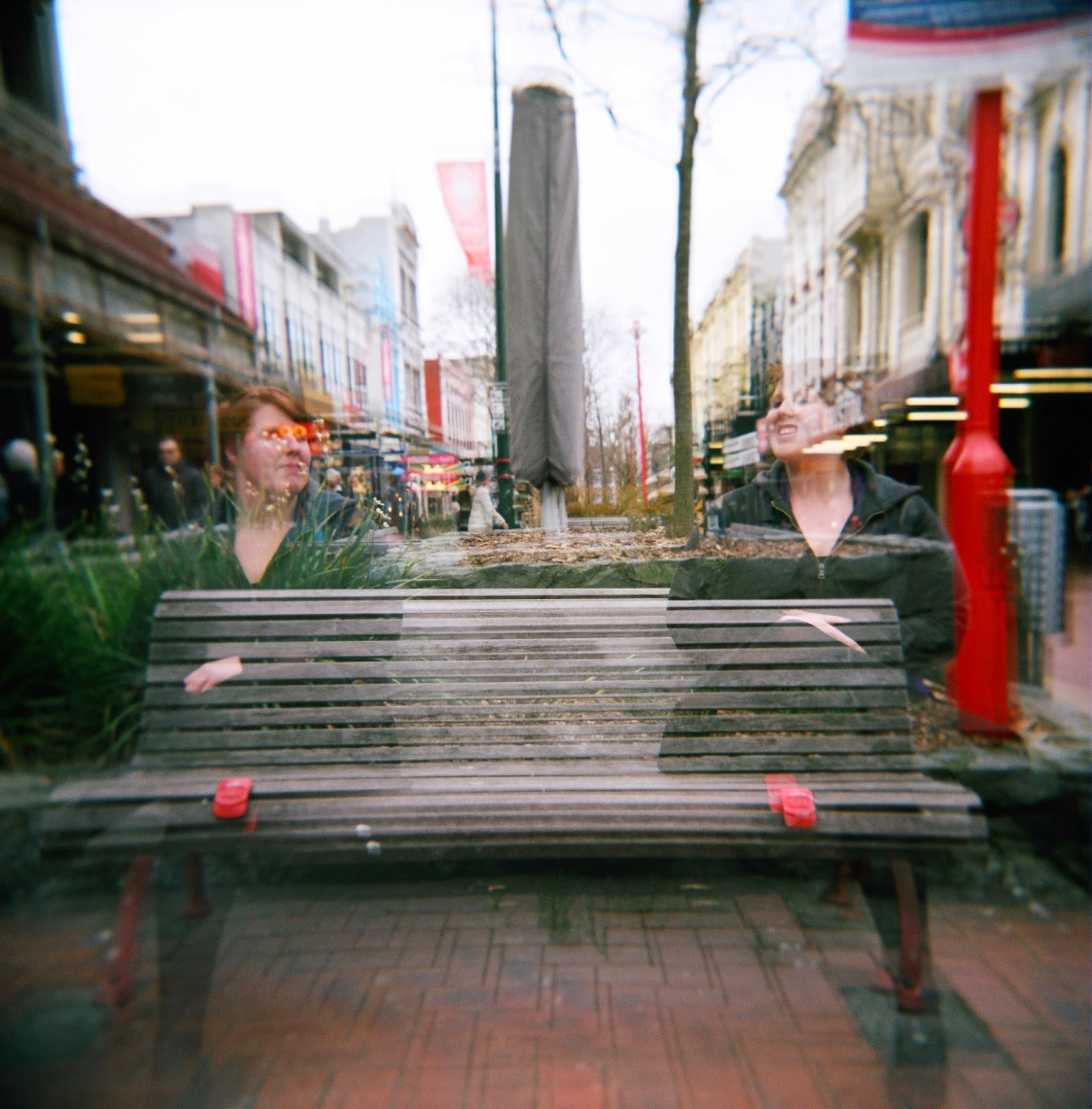
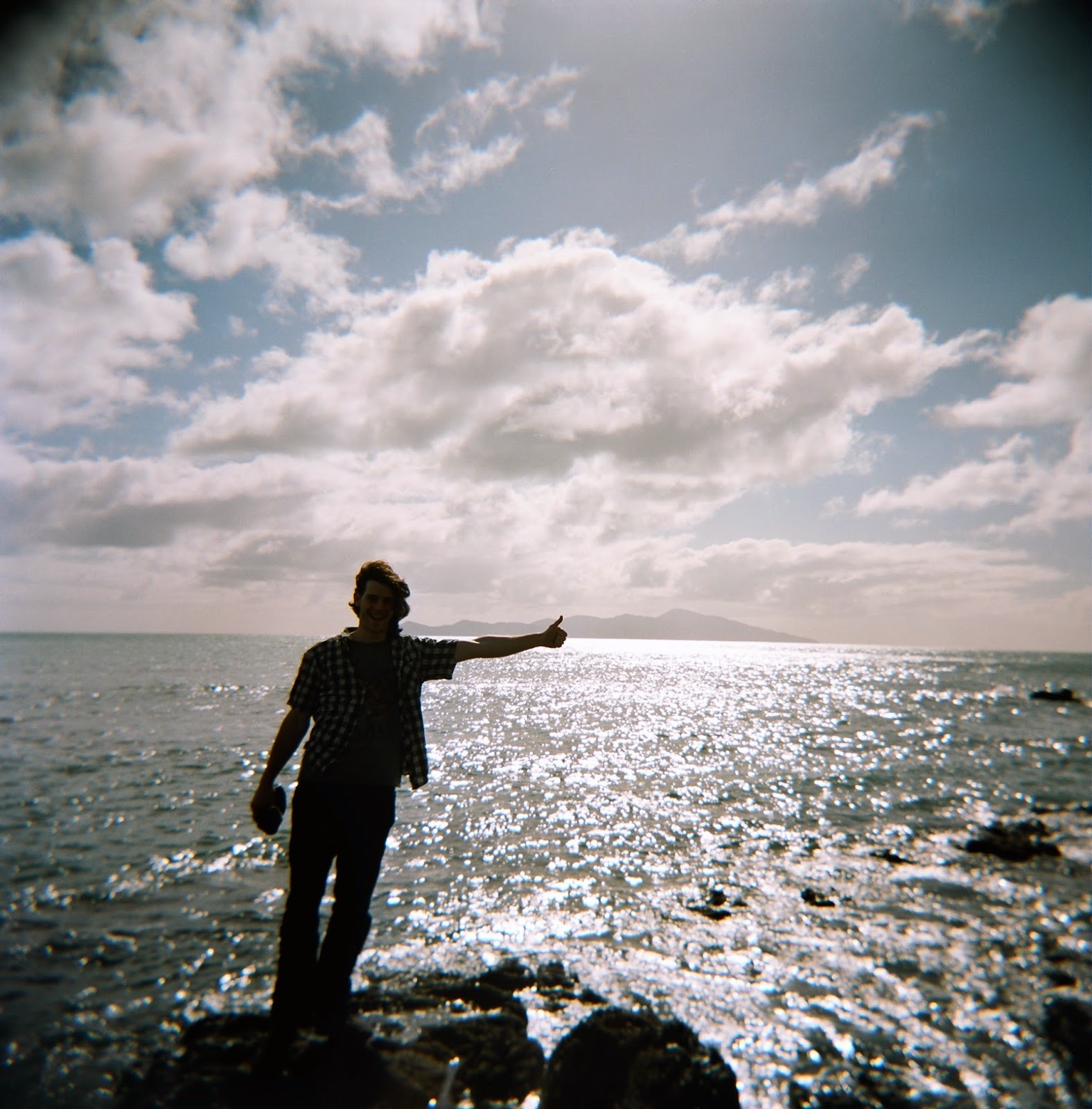
I have taken 12 images on the Holga thus far and am getting these developed at the trusty image lab around the corner (developing film is rather pricey). Of the images I have captured people, landscapes and some interesting buildings. I am interested at seeing the finished product and the quality of these images. I did some experimenting with double exposures these will be interesting to view.

My interesting idea for remediation of these images occured in Otaki where after checking both ways I lay down on in the middle of the train tracks and took a photograph (at my own risk; don't try this at home). Here I had the idea that I could develop the image and tape it to the railway track and assess its texture after it has been run over by a train.
I have never done it before but my friends have told me that you can bend a coin by putting it on the train tracks, I want to try to achieve a similar effect with my photograph.

I have also thought about expanding this idea to include other forms of transport, for example I would take an image of my car and then tape the image to one of the cars wheels and drive a distance before removing it.


I am sure I could also try to do this with bicycles, skateboards, and other modes of transport, but first I will test it on the developed images and on the train tracks. (Safely of course.)

Friday, 15 August 2014

Holga

Friday we started our adventure into project 2. Throughout the last week I have searched trade me and  the local photo shops for fairly priced film. I ended up winning an auction in Auckland and the package got here in sonly a few days, The package contained an assortment of photo film. I will explore the use of these film types whether as they were intended or in other creative ways.


We have been told of the functions of the Holga camera and they are simple but sufficient.


The film must be loaded in the camera carefully by inserting the film into the left and then threading the film into the spool on the right side.

There is no zoom

There is a very basic focus that can focus on a person, a few people, a larger group of people, and mountains.

You must take off the lens cap to expose the film when taking images.

You can take photos in two ways B bulb mode and N normal mode. Normal mode exposes images at 1/60 of a second. Bulb mode exposes the image for as long as you hold down the shutter button.

There is a basic aperture control switch that changes between Sunny F11 and Cloudy F8.

Don't forget to wind the film after each exposure.

Don't expose the film to light when removing it from the camera.


We were also given the following "rules" to follow from the Lomo website:


1. Take your camera everywhere you go.
2. Use it anytime, day and night.
3. Lomography is not an interference in your life, but part of it
4. Try the shot from the hip.
5.Approach the objects of your homographic desire as closely as possible.
6. Don't think.
7. Be Fast.
8. You don't have to know beforehand what you captures on film.
9. Afterwards, either.
10. Don't worry about any rules.