Showing posts with label Plastic. Show all posts

Wednesday, 21 October 2015

More plastic movement experiments.


These are merely the pieces of wood that are cut out when using a circular drill bit, however, when melting plastic it is a good idea to have something pushing down into the mould, so reusing these is a brilliant idea.


And here is the mould itself. I used this one a couple of times, if the plastic is done perfectly, melted well and formed into a full cylinder but not overcooked and burnt enough to ruin the plastic, it should pop out easily with a few taps of a hammer. perfect.


This mock-up tried to make physical one of my ideas I had sketched up, using one motor to spin several dowels. The frame worked well, using a few pieces of duct tape held it all together, but rubber bands didnt want to work for me and I didn't know what else would.

This here is just an off cut from when I truncated another cylinder. It could be used again to form another shape.


When you have melted a batch of plastic but all of your main moulds are full, instead of letting it set to the inside of a pot you should use it up by setting it in another mould. Here I have made a couple of patties by setting the leftovers in a large flat mould.


This piece is small, but has some nice features like the corrugations of the wood that was used to press down upon it. The orange colour is from a bottle cap and makes for a neat marbled colour.

Tuesday, 20 October 2015

Concept Sketches

The following is a collection of my sketches for ideas of moving parts involving a simple motor.
Above: the motor will share the rotation with some dowels via rubber bands or similar. Attached is a band with different length metal pieces on it. Each piece will make a different noise as it hits something as it goes around,

One motor is powering the rotation of several dowels with fans or windmill like structures attached  to them.

The motor turns a large truncated cylinder which in turn makes the wires rise and fall through the top piece.


One motor makes four dowels spin in different places in the shape of a cross.
Similar to the previous one; the motor seperates its energy into four parts of a cross. This time, with pencils or pens. Each point of the cross will have a point of the pencil on the paper below. as it spins it will create different textures.


A rack of different dowels that will spin and create sound as the metal strips on their ends come into contact with something, maybe one another.

Tuesday, 13 October 2015

Plastic mockup

For my 21st birthday a year ago I was gifted a bunch of screens and a stand for them; recently I've become near addicted to the Ryobi power tool range, I purchased an amazing white light; therefore I pretty much have my own photography booth ready to set up when I need it.


I continued with my melting of recycled plastic, this time hollowing out a fence post as a circular mould. this was rather laborious with a handheld drill. 
I smacked it out with a hammer and sanded it down a bit. It looked mostly pretty good.


With a second less perfect piece I was able to saw off the excess on an angle so that I had a smooth truncated cylinder. (albeit with a few air bubble holes in it).
This was the start of my idea for a final form that had moving parts involved.
I want to hollow out the main plastic cylinder enough to house the electrical components, then I want to build a wire frame to hold a 3D printed piece above. In between a truncated cylinder will spin around. On top of this  will be numerous wires that will bob up and down in a controlled manner with the spinning.


Seen here, is the two plastic pieces, connected by the motor which is hiding in a hollow.

Tuesday, 29 September 2015

Melting Plastic revisited


For the final project I don't have a lot of inspiration as to where to go. In the last project I feel I exhausted my exploration of plaster. I do however have left over recycled plastic from my first project that could be turned into something new.

I enjoyed the first project, making something completely new out of a waste material. I would like to further explore the properties of waste plastic, in particular giving it a more purposeful shape.


One of the parts I like about moulding recycled plastic is the application of heat required. I like to use fire in a controlled way to apply heat correctly to get the desired result.


Another learning experience in using plastic is in creating the moulds for the melted plastic to shape to. In the past project I used simple rectangular moulds with different depths, each with a different sized stamp which was used to push down the liquid plastic to allow any air bubbles to rise out of it.

At this stage I feel I may use a solid base in which I can setup my circuit.

Wednesday, 29 July 2015

Melted plastic pancake.


After washing my plastic I chucked some of it into an old pot and melted it down. I did it in the kitchen with the extractor fan on full blast. Supposedly the correct plastic (Recyclable plastic 2) won't let of any toxic fumes, so I must not have identified all of plastic correctly because it smelled terrible.
 
I estimated that it was all thoroughly melted without opening the lid to check.
I took it outside, scooped it out onto my pre-made sandwhiching board (mdf coated in tin foil) and clamped it tight shut.
 
Every 10 or so minutes I tightened the clamps. Plastic shrinks when it cools and this prevents cracking and bubbling.
 
After an hour of cooling I opened up my sandwich press to find this:
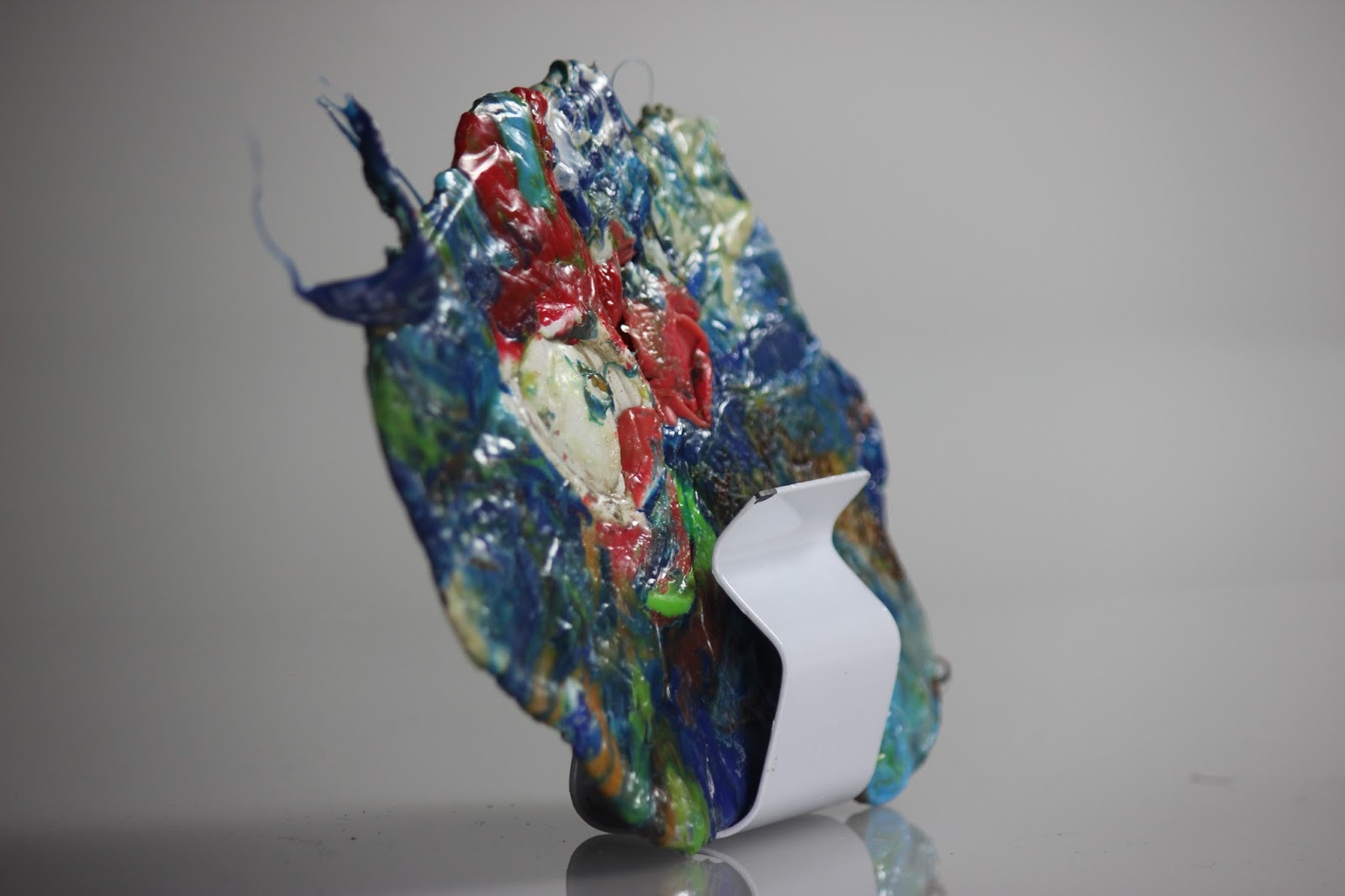
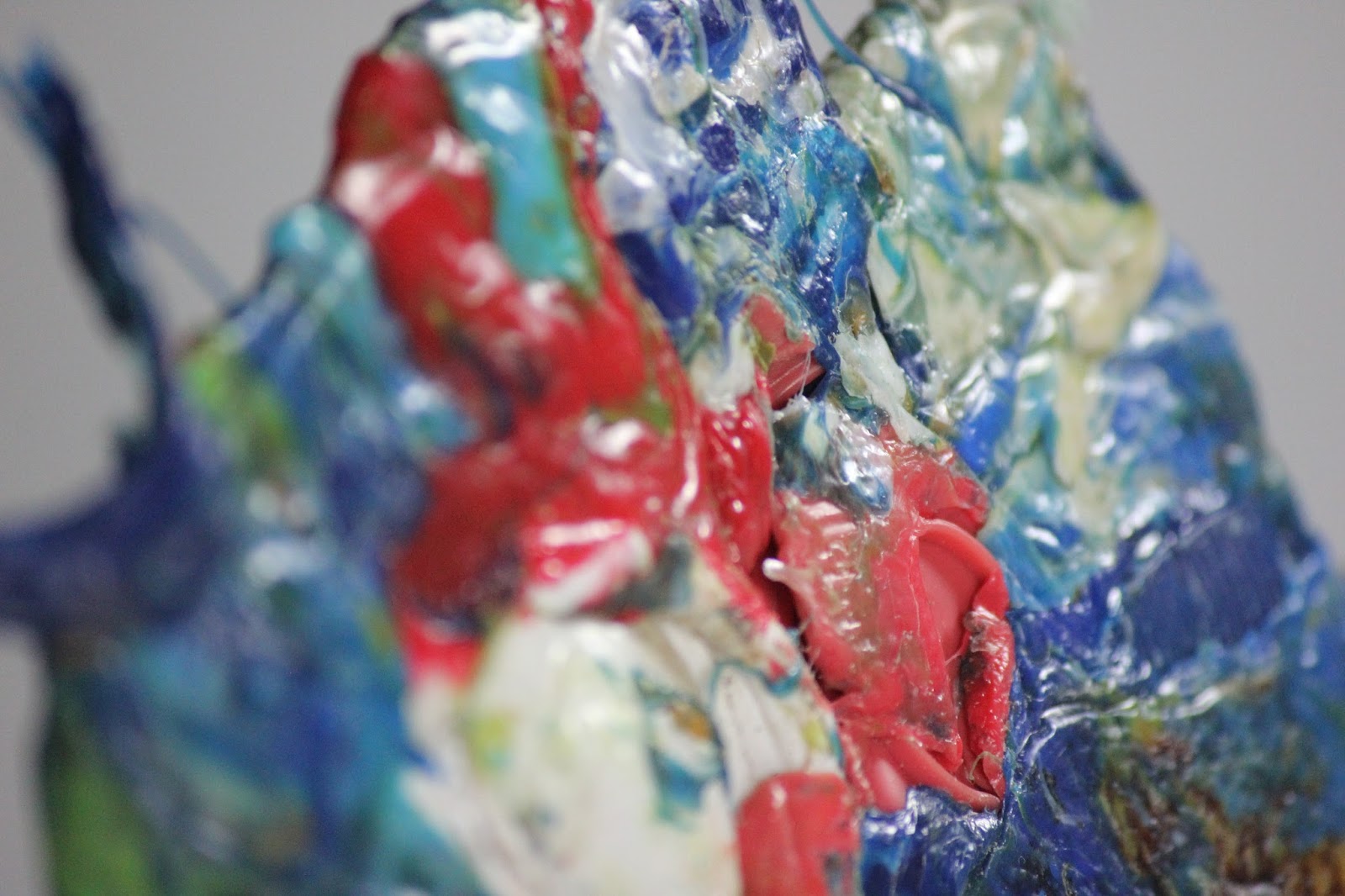
a colourful globular pancake of plastic. Some pieces had melted better than others.
 
There were numerous interesting colours and shapes, so I took a fair few photos.


This image is my chosen favourite for the week.
The presence of the green boottle cap from a bottle of 'kiwi-blue' stands out for me. It isn't completely melted and has significant meaning to it.
Most brands of water, especially in New Zealand like to proclaim themselves as pure and good for the environment, however this doesn't stop the consumer of the product from dumping the bottlecaps on the beach or in a river.
Something so 'pure' can be washed out to sea, eaten by fish,birds, or other animals and choke them to death.
 
I also liked the comparison of beach plastic, and the practical plastic in the photo lab reflecting the image.