Tonight I was filling beer cans up with cement. Tomorrow in our Studio I will take these in (dependent on whether the cement sets in time.) and experiment with strapping them to my shoes and to see how other people feel about the off balancing of my shoes.
Problem solving now comes into it as I start to prototype. I am yet to discover if cement is the ideal material to use, If it turns out to not be the best material I will investigate metals and others.
Tonight I had to overcome the problem of getting cement into the cans but did this using a mixture of pushing wet cement into the cans and pouring powdered cement and water into the can and mixing it up inside.
There was also the problem of emptying the beer cans...
Thursday, 9 August 2012

Wednesday, 8 August 2012
Pattern Maker
Today we opened up Pattern Maker, a code created by Ben Jack.
With this code you can enter your own code for a shape in a certain place. When played your coded shape will be repeated, forming a pattern.
I played around a bit with this function as well as some other functions, including the random number function, colour function, and the 3d shapes functions.
The random function allowed me to randomly gerenate different strokeWeights and line positions.
In the images shown below I have used red and blue. I have also played around with other colours and tones. I found out that I can pick a colour using photoshops colour selector and then enter in the Red, Green, and Blue values into processing to give me the same colour.
Over the next few days I will experiment with some of these features to make further patterns.
With this code you can enter your own code for a shape in a certain place. When played your coded shape will be repeated, forming a pattern.
I played around a bit with this function as well as some other functions, including the random number function, colour function, and the 3d shapes functions.
The random function allowed me to randomly gerenate different strokeWeights and line positions.
In the images shown below I have used red and blue. I have also played around with other colours and tones. I found out that I can pick a colour using photoshops colour selector and then enter in the Red, Green, and Blue values into processing to give me the same colour.
 |
| Random strokeWeight and line orientation, elipse and line tool. |
 |
| As above, but with colour change. |
 |
| Seemingly random small circles on circles of different blue tones. |
 |
| As above, but with a varying line. |
 |
| 3d spheres and rectangles. Experiements with depth. |
Over the next few days I will experiment with some of these features to make further patterns.
Monday, 6 August 2012
Storyboard And Words.
 |
| Storyboard |
My interaction is to do with how we treat our feet. Most of
us do take our feet for granted, we think of them as smelly and gross, but we
do not take time to thank them for their job of co-ordinating our everyday
movements.
We learn to walk once and from then on never think about it
again, it becomes second nature to us. What happens when our feet (or shoes)
are altered? We lose our co-ordination with the way we walk.
I want to experiment with how we humans learn to adapt to
changes in the weight of our feet and therefore how we learn to walk in a new
way.
My interactive object is a pair of shoes that have attached
to them different weighted objects. On one shoe is a heavy brick, on the other
shoe some lightweight aluminium cans. In order to walk in these shoes you must
make sure that you place even weight on the cans to ensure that they do not
crumble under your weight.
The idea is to acknowledge the unfamiliarity of wearing
differently weighted shoes, the crushing of the can when the user fails is a
way of measuring this.
Saturday, 4 August 2012
Weighted Shoes
One idea I have is a pair of shoes that appear to be regular shoes but once they are on the user realizes that they are both different weights, one light, one heavy. This will play with the users preconceptions of footwear.
I have inestigated some materials that I could attach to the bottom of the gumboots.
My first thoughts are bricks on the heavy shoe and aluminium cans on the light shoe.
Bricks are obviosly heavy and aluminium cans are lightweight and strong enough to support your weight if you distribute your weight on them evenly. The cans will crumble if they are stood on with an uneven weight; this will show if a person has failed.
Other objects I am yet to investigate are toilet paper and cardboard; these could potentially be on the light shoe as materials that will support a person and are lightweight.
I will most likely be using a large sized pair of gumboots for my final object. This is so people of most sizes will be able to use them, and also so they can slip onto a foot without being moved.
Images found at
http://moon-boots.blogspot.co.nz/2011/09/gumboots.html
I have inestigated some materials that I could attach to the bottom of the gumboots.
My first thoughts are bricks on the heavy shoe and aluminium cans on the light shoe.
Bricks are obviosly heavy and aluminium cans are lightweight and strong enough to support your weight if you distribute your weight on them evenly. The cans will crumble if they are stood on with an uneven weight; this will show if a person has failed.
Other objects I am yet to investigate are toilet paper and cardboard; these could potentially be on the light shoe as materials that will support a person and are lightweight.
 |
| Gumboots |
Images found at
http://moon-boots.blogspot.co.nz/2011/09/gumboots.html
Tug-Of-War
A concept I had for an interactive experience is a reenactment of a tug-of-war. An unpleasant experience that I myself has had as a child is when competing in a tug-of-war the other team lets go of the rope resulting in you and all of your team falling over in surprise on top of one another.
There is the feeling of pulling a rope and feeling it resist your pull; and the feeling of pulling a rope too hard and feeling the rope release at the other end resulting in your fall.
I wanted to create an object that allowed you to feel these two sensations of when the rope is tight and slack.
Firstly I thought this could be done using a large wall with a hole in it. Through this hole the rope is threaded. A peg is threaded through the rope on the hidden side, this prevents the rope from being pulled furthur. Randomly the peg would be removed, the next pull on the rope would result in the user falling over.
A model could be made of this using smaller materials to test it out.
Another idea is that there are three ropes, each with a different length of slack rope, if you pulled each rope as hard as you can, the shortest one would pull back against you, the longest one would be too long and so you would fall over, and one would be in between.
Again, these would need to be tested.
There is the feeling of pulling a rope and feeling it resist your pull; and the feeling of pulling a rope too hard and feeling the rope release at the other end resulting in your fall.
I wanted to create an object that allowed you to feel these two sensations of when the rope is tight and slack.
Firstly I thought this could be done using a large wall with a hole in it. Through this hole the rope is threaded. A peg is threaded through the rope on the hidden side, this prevents the rope from being pulled furthur. Randomly the peg would be removed, the next pull on the rope would result in the user falling over.
A model could be made of this using smaller materials to test it out.
Another idea is that there are three ropes, each with a different length of slack rope, if you pulled each rope as hard as you can, the shortest one would pull back against you, the longest one would be too long and so you would fall over, and one would be in between.
Again, these would need to be tested.
Friday, 3 August 2012


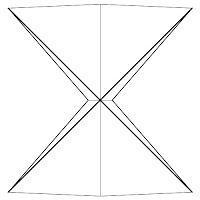


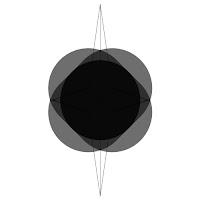


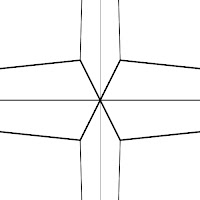
Final Code Project 1
Here is my final code for Project 1:
int x = 250;
int y = 250;
int h = 200;
int h2= 100;
int w = 1000;
int w2= 50;
void setup(){
size(500,500);
smooth();
background(255);
stroke(0);
strokeWeight (1);
line (x,y,x,y-h);
line (x,y,x,y+h);
strokeWeight (3);
line (x,y,x+w,y);
line (x,y,x-w,y);
stroke(0);
strokeWeight (4);
line (x,y,x-w2,y-h2);
line (x,y,x-w2,y+h2);
line (x,y,x+w2,y-h2);
line (x,y,x+w2,y+h2);
stroke(0);
strokeWeight (2);
line (x,y-h,x-w2,y-h2);
line (x,y-h,x+w2,y-h2);
line (x,y+h,x-w2,y+h2);
line (x,y+h,x+w2,y+h2);
strokeWeight (4);
line (x-w,y,x-w2,y-h2);
line (x-w,y,x-w2,y+h2);
line (x+w,y,x+w2,y-h2);
line (x+w,y,x+w2,y+h2);
}
void draw(){}
void keyPressed(){
save(selectOutput());
}
Variables that I have changed are strokeweight of lines, stroke opacity, and lengths of widths and height.
int x = 250;
int y = 250;
int h = 200;
int h2= 100;
int w = 1000;
int w2= 50;
void setup(){
size(500,500);
smooth();
background(255);
stroke(0);
strokeWeight (1);
line (x,y,x,y-h);
line (x,y,x,y+h);
strokeWeight (3);
line (x,y,x+w,y);
line (x,y,x-w,y);
stroke(0);
strokeWeight (4);
line (x,y,x-w2,y-h2);
line (x,y,x-w2,y+h2);
line (x,y,x+w2,y-h2);
line (x,y,x+w2,y+h2);
stroke(0);
strokeWeight (2);
line (x,y-h,x-w2,y-h2);
line (x,y-h,x+w2,y-h2);
line (x,y+h,x-w2,y+h2);
line (x,y+h,x+w2,y+h2);
strokeWeight (4);
line (x-w,y,x-w2,y-h2);
line (x-w,y,x-w2,y+h2);
line (x+w,y,x+w2,y-h2);
line (x+w,y,x+w2,y+h2);
}
void draw(){}
void keyPressed(){
save(selectOutput());
}
Variables that I have changed are strokeweight of lines, stroke opacity, and lengths of widths and height.
Subscribe to:
Comments (Atom)